Our pick VEVOR Pizza Steel
Check price on AmazonThin Crust Pizza Dough Recipe: Tavern and Cracker Style
A low hydration dough you roll with a pin instead of stretching: 50 percent water, 4 percent oil, enough for two 14 inch tavern style pies. Below: grams and cups, the cracker crust variation, the timeline, and how to bake it on a stone, a steel, a screen or in a pizza oven without burning it.
We earn a commission on purchases through our links, at no cost to you. How this works

Quick answer
- Formula: 100 percent flour, 50 percent water, 4 percent oil, 2 percent salt, 1 percent sugar, 0.4 percent instant yeast. For cracker crust, use 45 percent water.
- Batch: 255 g flour, 128 g water, 10 g oil, 5 g salt, 3 g sugar, 1 g instant yeast. Makes two 190 g balls for 14 inch pies.
- Roll, do not stretch. Low hydration dough is too stiff to stretch by hand but rolls cleanly to 1/8 inch or thinner.
- Dough weight is at the low end of our dough per pizza band, about 1.2 g per square inch, because rolling spreads dough evenly with no thick rim.
- Dock the rolled dough with a fork or docker to stop large bubbles, especially for cracker crust.
- Bake at 475 to 500°F for 7 to 10 minutes. In a pizza oven, run the floor at about 550 to 650°F; full 900°F heat will scorch a thin base before the top cooks.
Short answer: mix 255 g all purpose or bread flour, 128 g water, 10 g olive oil, 5 g salt, 3 g sugar and 1 g instant yeast, rest it at least 2 hours or overnight in the fridge, then roll each 190 g half to 14 inches and about 1/8 inch thick. Bake at 500°F on a stone or steel for 7 to 10 minutes. For a cracker crust, drop the water to 45 percent and roll thinner.
Thin crust is mostly about hydration. Every hand stretched style on our hydration table starts at 55.6 percent or higher, because a dough has to be soft and extensible to stretch by hand. A rolled dough does not. At 45 to 50 percent the dough is stiff enough to roll paper thin without sticking or springing back, and it bakes into a crisp, even base with almost no rim.
Two regional styles live here. Tavern style, the thin, square cut pizza of the Midwest, is crisp but still has a little chew. Cracker crust is drier and thinner still and snaps rather than bends. Both use the same method; the difference is a few points of water and how thin you roll.
What you'll need
The five tools that do the work in every method on this site: a slab that stores heat, something to launch with, a way to read the surface, and a clean cut.


In this guide
The recipe in grams, cups and baker's percentages
Two 190 g balls for 14 inch pies. Halve the batch for one pie or double it for four.
| Ingredient | Grams | Approx. volume | Baker's % |
|---|---|---|---|
| All purpose or bread flour | 255 g | 2 cups plus 2 tbsp | 100% |
| Warm water | 128 g | 1/2 cup plus 2 tsp | 50% |
| Olive oil | 10 g | 2 1/4 tsp | 4% |
| Fine sea salt | 5 g | a scant 1 tsp | 2% |
| Sugar | 3 g | 3/4 tsp | 1% |
| Instant yeast | 1 g | about 1/3 tsp | 0.4% |
Dough weight. A 14 inch pizza has an area of 153.9 square inches. At the low end of the 1.2 to 1.7 g per square inch band on our dough per pizza page, that is 186 g. 190 g leaves a little to trim. A hand stretched pizza needs more because it carries a puffy rim; a rolled thin crust spreads the dough evenly to the edge, so the low end is enough. The pizza dough calculator scales this formula to other sizes and counts.
Why the oil is higher. At 4 percent, oil does two jobs in a low water dough: it makes the stiff dough easier to roll, and it helps the base fry slightly against the hot stone so it turns crisp rather than hard.
Equipment
Thin crust needs even bottom heat and a way to roll the dough flat. Pick the gear that matches the bake.
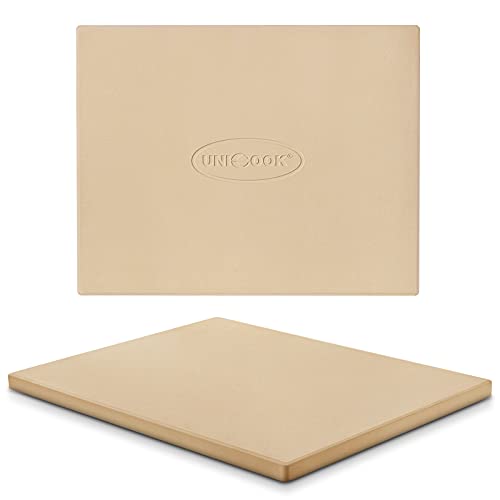
- Unicook cordierite pizza stone: a stone's gentler heat suits a thin base that would scorch on a very hot steel. See best pizza stones and steels.
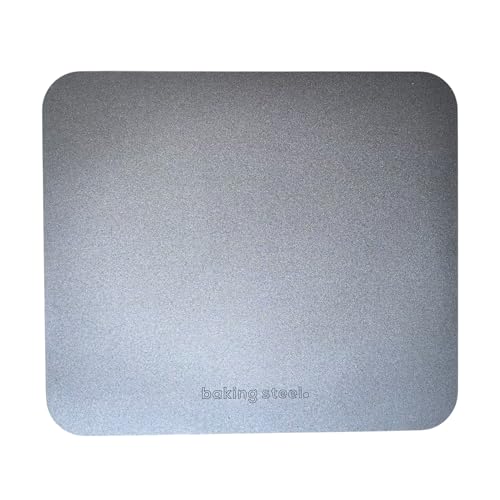
- Baking Steel Original: the better choice if your oven only reaches 475°F and you want a faster, crisper base. Ranked in best pizza steel.
- American Metalcraft 14 inch pizza screen: build the pizza on the screen and slide it onto the stone, which removes the hardest part, launching a floppy thin sheet. More in best pizza screen.
- J.K. Adams French rolling pin: a long tapered pin rolls a stiff 50 percent dough to an even 1/8 inch and turns easily as you work around the round.
- Orblue pizza dough docker: pricks the whole sheet in a few passes so steam escapes and cracker crust bakes flat. A fork works, more slowly.
Tavern style vs cracker crust
| Tavern style | Cracker crust | |
|---|---|---|
| Water | 50% | 45% |
| Rolled thickness | about 1/8 inch | as thin as possible |
| Docking | light | thorough, edge to edge |
| Texture | crisp with slight chew | snaps like a cracker |
| Cut | small squares | squares or wedges |
Tavern style is the bar pizza of Chicago and much of the Midwest: thin, crisp, sauced and topped right to the edge, and cut into a grid of small squares. The dough has just enough water to keep a little chew.
Cracker crust pushes further. At 45 percent water the dough is barely cohesive, which is the point. For cracker crust, use 115 g water instead of 128 g on the same 255 g of flour, roll it until you can almost see the counter through it, dock it thoroughly, and bake it a minute or two longer. For a hand stretched, foldable pie instead, see the New York pizza dough recipe. Some bakers leave the rolled sheet uncovered for 15 to 30 minutes before topping so the surface dries slightly, which makes the crust even crisper.
Timeline
| Step | Same day | Make ahead |
|---|---|---|
| Mix and knead | 10 min | 10 min |
| Rest | 2 h at room temp | overnight to 3 days, fridge |
| Warm before rolling | not needed | 30 to 60 min |
| Roll and dock | 5 min per pie | 5 min per pie |
| Preheat oven and stone | 45 to 60 min | 45 to 60 min |
| Bake | 7 to 10 min | 7 to 10 min |
Thin crust does not need a long ferment for texture, because it does not rely on a puffy, open crumb. A night in the fridge does improve the flavor and makes the dough easier to roll. The general trade off is in cold ferment vs same day pizza dough.
Bake settings: stone, steel, screen and pizza oven
Home oven with a stone. Stone on the lower middle rack, oven at 500°F, preheat 45 to 60 minutes. Bake 8 to 10 minutes until the underside is evenly golden. A stone's slower heat transfer is a good match for a thin base. More in how to use a pizza stone.
Home oven with a steel. A steel transfers heat much faster, so set the oven to 475°F and place the steel in the middle rather than the top. Bake 6 to 8 minutes and check the underside at 5.
On a screen. Build the pizza on a screen, bake it on the screen on top of the stone for the first 4 to 5 minutes, then slide it off the screen directly onto the stone to finish crisping.
Pizza oven. A thin base has almost no mass, so a 900°F floor burns it in seconds. Let the oven heat, then turn the flame low and let the floor settle around 550 to 650°F. Bake 2 to 4 minutes, turning often. If the base chars before the cheese melts, the floor is still too hot.
| Setup | Temp | Bake time |
|---|---|---|
| Home oven + stone | 500°F | 8 to 10 min |
| Home oven + steel | 475°F | 6 to 8 min |
| Screen, then stone | 500°F | 8 to 10 min total |
| Pizza oven, flame low | 550 to 650°F floor | 2 to 4 min |
Rolling technique and common problems
Roll from the center out. Start in the middle and roll toward the edge, lift the pin, return to the center and roll toward the opposite edge. Give the dough a quarter turn every couple of passes so it stays round and does not stick.
If it shrinks back, the gluten is tight. Cover it for 5 to 10 minutes and roll again. This is more common with bread flour than all purpose.
If it cracks at the edges, the dough is too dry for your flour. Add water a teaspoon at a time next batch, or let the rolled sheet rest under a towel for a few minutes before trimming.
If the middle bubbles up, dock more. Large bubbles in a thin crust usually mean steam trapped under an undocked section.
If the center is soggy, the sauce is too heavy for a thin base. Use a thin layer, about 60 to 80 g for a 14 inch pie, and keep wet toppings light. More in why is my pizza soggy in the middle.
How to Make Thin Crust Pizza Dough
- 1
Mix
Combine 255 g flour, 3 g sugar, 1 g instant yeast and 5 g salt. Add 128 g warm water and 10 g olive oil and mix until no dry flour remains. The dough will look dry and shaggy at first.
- 2
Knead briefly
Knead 5 to 6 minutes by hand or 4 to 5 minutes on low in a mixer, until it forms a firm, smooth dough. It will be much stiffer than a normal pizza dough. That is correct.
- 3
Rest
Cover and rest at least 2 hours at room temperature, or refrigerate overnight and up to 3 days. The rest relaxes the gluten so the dough rolls without shrinking back.
- 4
Divide
Cut into two 190 g pieces and flatten each into a disc. If refrigerated, let them sit 30 to 60 minutes before rolling.
- 5
Roll thin
On a lightly floured surface, roll each disc from the center outward, turning it a quarter turn after each pass, to 14 inches and about 1/8 inch thick for tavern style, or as thin as you can for cracker crust.
- 6
Dock and trim
Prick the dough all over with a fork or docker. Trim the edge to a neat circle if you want the clean tavern look.
- 7
Top to the edge and bake
Spread sauce thinly almost to the edge, add cheese and toppings, and bake at 475 to 500°F on a preheated stone or steel for 7 to 10 minutes, until the base is crisp and evenly brown.
- 8
Cut into squares
Tavern style is cut in a grid of small squares rather than wedges. Let it rest 1 minute so the cheese sets, then cut.
Ready to buy? Start with our top picks
Whatever this guide steered you toward, here's where most readers land. Live price check on each.
- Check price on Amazon

- Check price on Amazon

- Check price on Amazon

- Check price on Amazon

- Check price on Amazon

- Check price on Amazon

As an Amazon Associate we earn from qualifying purchases, at no cost to you.
How we researched this
The formula is a standard baker's percentage build for rolled thin crust and is not attributed to a named authority. Hydration is placed relative to the sourced style table on our hydration page; ball weight follows the arithmetic on our dough per pizza page.
Volume conversions use 120 g per cup of flour and 237 g per cup of water, and are approximate.
Tavern style and cracker crust are described by their common characteristics. We do not attribute either to a specific pizzeria or claim a definitive recipe for either.
We ran no physical tests. This is a research and verification desk.
Key terms
- Tavern style
- A thin, crisp, rolled pizza associated with Chicago bars, topped to the edge and cut into small squares.
- Cracker crust
- A very thin, very low hydration crust that snaps rather than bends, usually docked thoroughly before baking.
- Docking
- Pricking rolled dough with a fork or spiked roller so steam escapes and the base bakes flat without large bubbles.
- Low hydration dough
- Dough with water well under 55 percent of the flour weight. Too stiff to stretch by hand but easy to roll thin.
Frequently asked questions
What hydration is thin crust pizza dough?
About 45 to 50 percent. This recipe uses 50 percent for tavern style and 45 percent for cracker crust. That is lower than any hand stretched style, which start around 55.6 percent, because a rolled dough does not need to be extensible.
Should I use a rolling pin for thin crust pizza?
Yes, for a rolled thin crust. Low hydration dough is too stiff to stretch evenly by hand, and a pin gives a uniform thickness with no thick rim. Hand stretching suits higher hydration styles like Neapolitan and New York.
What is the difference between tavern style and cracker crust?
Water and thickness. Tavern style uses about 50 percent hydration, is rolled to about 1/8 inch and keeps a slight chew. Cracker crust uses about 45 percent, is rolled thinner and docked thoroughly, and snaps when you bite it.
How much dough for a 14 inch thin crust pizza?
About 186 to 190 g, which is the low end of the 1.2 to 1.7 g per square inch band on our dough per pizza page. A rolled crust spreads dough evenly with no rim, so it needs less than a hand stretched pizza of the same size.
What temperature do you bake thin crust pizza at?
475 to 500°F in a home oven for 6 to 10 minutes on a preheated stone or steel. In a pizza oven, turn the flame down so the floor is around 550 to 650°F; full heat will burn a thin base.
Why is my thin crust pizza not crispy?
Usually too much sauce, an underheated stone, or too little time. Preheat the stone 45 to 60 minutes, use a thin layer of sauce, and bake until the underside is evenly golden. Finishing directly on the stone after a screen also helps.
Filed under Explainer · Part of Pizza Recipes
Keep reading
Pizza Dough Hydration Explained
Why every hand stretched style runs wetter than a rolled thin crust.
How Much Dough Per Pizza
Dough weight by size, calculated from area.
How to Use a Pizza Stone
Preheat and rack position for a crisp thin base.
Best Pizza Screen
Screens that make thin crust easy to build and bake.
Best Pizza Stones and Steels
Which surface suits thin crust and which suits thicker styles.
The Bake, free weekly
Price drops worth knowing about, technique that matters, and every new review.