Our pick. Ooni
Check price on Amazon →How Much Dough Per Pizza: The Weight Table, With the Arithmetic Shown
Roughly 1.2 to 1.7 g of dough per square inch of finished pizza, which puts a 12 inch pizza at about 137 to 190 g. That band is our own arithmetic, derived from Commission Regulation (EU) No 97/2010, which specifies dough balls of 180 to 250 g for a pizza of no more than 35 cm. Below: the full table by size with the area column visible so you can check the working, plus the disagreement between the EU regulation and the AVPN's own recipe.
By The Pizza Oven Review DeskUpdated 2026-08-08~10 min readRanked on verified floor heatHow we research
We earn a commission on purchases through our links, at no cost to you. It never decides a ranking. How this works

Our pick.
Zojirushi Virtuoso Plus BB-PDC20Best Overall. From Best Bread Machines for Pizza Dough (2026).
A 12 inch pizza wants about 137 to 190 g of dough, and that comes from a single rate: roughly 1.2 to 1.7 g of dough per square inch of finished pizza. Everything else on this page is that one rate multiplied by an area. The rate is our own arithmetic and we are going to show you exactly where it comes from, because a dough weight table you cannot check is just a list of numbers somebody typed.
Here is the source. Commission Regulation (EU) No 97/2010, which registered Pizza Napoletana as a Traditional Speciality Guaranteed, specifies that dough balls must weigh between 180 and 250 g, and that the finished pizza must not exceed 35 cm in diameter. Those two specifications together are a rate, because 35 cm is 13.78 inches, so the radius is 6.89 inches, and the area of that circle is pi multiplied by 6.89 squared, which is 149 square inches. Divide the regulation's own dough weights by its own maximum area and you get 180 divided by 149, which is 1.21 g per square inch, and 250 divided by 149, which is 1.68. Call it 1.2 to 1.7 g per square inch.
Then apply that rate to any size you like. The check that the method is sound is built into the table below: the 35 cm row reproduces the regulation's own 180 to 250 g, because that is the row the rate was derived from. Nothing else on the page is anything more exotic than pi r squared and a multiplication, and we publish the area column so you can verify every line yourself.
The short version.
- The rate is 1.2 to 1.7 g of dough per square inch of finished pizza. It is our derivation, not a published figure, and it comes from dividing Commission Regulation (EU) No 97/2010's own 180 to 250 g dough balls by the area of its own 35 cm maximum diameter, which is 149 square inches.
- For a 12 inch pizza that is 137 to 190 g. For a 14 inch it is 186 to 259 g, and for a 16 inch it is 243 to 338 g, because area grows with the square of the radius, not with the diameter.
- The 35 cm row of our table reproduces the regulation's published 180 to 250 g exactly. That is the check on the method, not a coincidence.
- The two Neapolitan authorities disagree on dough ball weight. The EU regulation says 180 to 250 g; the AVPN's own website recipe says 200 to 280 g. We print both rather than reconciling them.
- Using the AVPN figure over the same 149 square inches gives 1.34 to 1.88 g per square inch, a heavier and thicker pizza than the EU rate produces at every size.
- Rectangular and pan pizzas use identical arithmetic. Multiply length by width for the area, then apply the same grams per square inch. The shape does not change the rate.
Our top-rated pizza ovens
Whatever you decide, these are the ovens we recommend, ranked on stated floor heat. Live price check on each.
- Check price on Amazon

- Check price on Amazon

- Check price on Amazon

- Check price on Amazon

- Check price on Amazon

- Check price on Amazon

As an Amazon Associate we earn from qualifying purchases, at no cost to you.
What you'll need.
Prices approximate at time of writing.
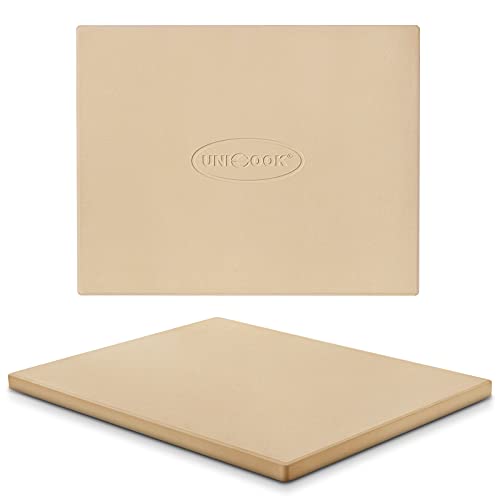
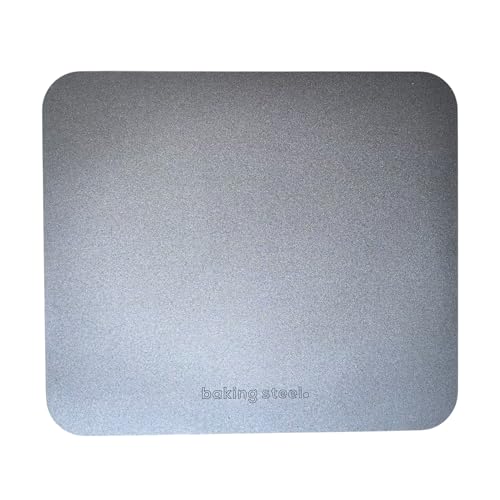
The five tools that do the work in every method on this site: a slab that stores heat, something to launch with, a way to read the surface, and a clean cut.


The derivation, in full, so you can check it
We are going to do this in public, because the whole value of the table below is that you do not have to take our word for it.
Step one, the published figures. Commission Regulation (EU) No 97/2010 specifies that the dough balls for Pizza Napoletana must weigh between 180 and 250 g. The same regulation specifies that the finished pizza must not exceed 35 cm in diameter. Both figures are in the regulation's own text. Nothing so far is ours.
Step two, the area. 35 cm is 13.78 inches, so the radius is 6.89 inches. The area of a circle is pi multiplied by the radius squared, so the area is pi multiplied by 6.89 squared, which is 149 square inches.
Step three, the division. The regulation's lightest permitted ball spread over its largest permitted pizza is 180 divided by 149, which is 1.21 g per square inch. Its heaviest ball over the same area is 250 divided by 149, which is 1.68 g per square inch. Rounded, that is the band this page runs on: 1.2 to 1.7 g of dough per square inch of finished pizza. That division is ours. The regulation does not publish a rate, it publishes a weight and a diameter, and the rate is what falls out when you put them together.
The table: dough ball weight by pizza size
Every row here is the same two multiplications: area, then area multiplied by the rate. The area column is printed on purpose so you can check any line with a calculator. All of it is our arithmetic, derived from the EU regulation's published figures.
| Pizza diameter | Area (sq in) | Dough ball at 1.2 g/sq in | Dough ball at 1.7 g/sq in |
|---|---|---|---|
| 10 in | 78.5 | 95 g | 132 g |
| 12 in | 113.1 | 137 g | 190 g |
| 13.8 in (35 cm, the AVPN and EU maximum) | 149.1 | 180 g | 250 g |
| 14 in | 153.9 | 186 g | 259 g |
| 16 in | 201.1 | 243 g | 338 g |
| 18 in | 254.5 | 308 g | 428 g |
Look at the 13.8 inch row, because it is the audit. 35 cm is the regulation's own maximum diameter, and at our derived rate that row returns 180 to 250 g, which is the regulation's own published dough ball range, exactly. That is not a coincidence and it is not us being clever; it is the row the rate was derived from, fed back through the method. We print it because a derived table that could not reproduce its own source row would be broken, and showing that it does is the only honest way to ask you to trust the other five rows.
The other thing that table teaches is worth internalising: dough requirement does not scale with diameter, it scales with area, which grows with the square of the radius. A 16 inch pizza is only a third wider than a 12 inch one, but it needs roughly 78 percent more dough, because 201.1 square inches against 113.1 is nearly double the surface. This is the single most common scaling error people make, and it is why stretching a 12 inch ball to 16 inches does not give you a thin crust, it gives you a pizza with holes in it. That failure is covered in why does my pizza dough tear.
The disagreement: 180 to 250 g or 200 to 280 g
Now the part most dough weight tables leave out. The two authorities that define Neapolitan pizza do not publish the same dough ball weight.
Commission Regulation (EU) No 97/2010 specifies dough balls of 180 to 250 g. The AVPN's own website recipe page specifies dough balls of 200 to 280 g. Same style, same 35 cm maximum diameter, two different weight ranges from two bodies that both have standing to define it. The AVPN figure is 20 g heavier at the bottom and 30 g heavier at the top. They overlap, but they are not the same specification, and there is no version of the arithmetic that makes them agree.
Run the AVPN figure through the identical method and here is what changes. 200 g over the same 149 square inches is 1.34 g per square inch, and 280 g over 149 is 1.88 g per square inch. So the AVPN recipe describes a rate of 1.34 to 1.88 g per square inch, which is heavier than the EU rate at both ends. Same diameter, more dough, therefore a thicker pizza. That is not a rounding difference, it is a different pizza, and it is consistent with the other place these two documents part company: as we document on our pizza oven temperature chart, the AVPN specifies a centre thickness of 0.25 to 0.30 cm while the EU regulation specifies 0.4 cm.
| Specification | Commission Regulation (EU) No 97/2010 | AVPN website recipe | Agree? |
|---|---|---|---|
| Dough ball weight | 180 to 250 g | 200 to 280 g | No |
| Maximum diameter | 35 cm | 35 cm | Yes |
| Grams per square inch (our derivation) | 1.21 to 1.68 | 1.34 to 1.88 | No, AVPN is heavier |
We are not going to average them. A table built on 190 to 265 g would be citing a figure neither body ever published, and the difference between the two is exactly the information you need to make a decision. Pick a document and run the whole batch on it.
Which end of the band to choose
Both ends of 1.2 to 1.7 g per square inch produce a legitimate pizza. Here is what actually separates them.
Choose the low end, around 1.2 g per square inch, if you want thinner and crisper. Less dough over the same area means a thinner base, a lower rim, less interior crumb to keep steaming, and a crust that goes crisp faster and stays crisp longer. It is the right end if you like a pizza you can hold flat, and it is the more forgiving end in a very hot oven, because there is less mass to get heat through in a bake of 60 to 90 seconds.
Choose the high end, around 1.7 g per square inch, if you want thicker and breadier. More dough over the same area gives you a taller rim, a more open and bready interior, and a pizza that behaves more like bread with toppings than a cracker with toppings. It is also the end to move toward if your pizzas keep tearing, because a heavier ball at the same diameter is stretched less thin and has more margin before it opens up.
Then check it against your bake. A short, very hot bake suits the lighter end, since a thick, wet base can leave the middle underdone before the rim is finished, which is the mechanism behind a soggy middle. A longer, cooler bake, of the kind our temperature chart attributes to New York style at 4 to 12 minutes, has time to cook a heavier base through. Dough weight is a partner to bake time in exactly the way hydration is, which is set out in pizza dough hydration explained.
Rectangular pans, and why the rate does not care about shape
Nothing in the derivation depends on the pizza being round. The rate is grams per square inch, and a square inch is a square inch, so for a rectangular pan pizza you multiply length by width to get the area and then apply exactly the same grams per square inch. Detroit, Sicilian, Roman al taglio and any home baking tray are all handled by that one substitution: swap pi r squared for length times width, and the rest of the method is unchanged.
Two honest caveats about carrying the rate across. First, the 1.2 to 1.7 band was derived from a Neapolitan specification, and the pan styles it is being applied to are generally thicker by design, so the top of the band is the natural starting point for a pan and the bottom of it will give you something quite lean. Second, pan doughs are usually much wetter: our hydration guide puts Detroit at 71 to 75 percent and Sicilian at 73.5 percent, against 55.6 to 62.5 percent for Neapolitan, and a wetter dough at the same weight spreads further and rises differently. Use the rate to get in the right neighbourhood, then adjust once by feel and write the number down.
For dividing and storing, the tooling matters more than people expect. A bench scraper cuts a clean division without dragging and degassing the dough the way a knife does, and every piece should go on the scale rather than being judged by eye. Once balled, the balls need to sit apart and covered, which is what a dough proofing box or a stack of commercial dough trays exists for. Balls that fuse have to be torn apart, and torn dough stretches unevenly no matter how precisely you weighed it. The wider kit is in best pizza dough tools.
Weighing, and the one place precision actually matters
Everything on this page assumes a scale, because a dough weight table is worthless if the balls are divided by eye. Two 12 inch balls at 137 g and 190 g are both defensible pizzas from our table, but they are visibly different pizzas, and that entire difference is inside the margin of a confident guess. A kitchen scale reading to 1 g is all this page needs; if you are mixing large batches, a higher capacity scale saves you weighing flour in stages. The comparison is in best kitchen scales for baking.
Where 1 g resolution stops being enough is not dough weight, it is yeast. The AVPN's web recipe permits as little as 0.1 g of fresh yeast per litre of water, a quantity a 1 g scale cannot register at all, and that arithmetic and its consequences are dealt with in pizza dough salt and yeast ratios. For flour, water and dough balls, 1 g is plenty.
Finally, remember that dough ball weight and fermentation are separate dials. The regulation's ball weight says nothing about how long the ball rests before you stretch it, and the two Neapolitan authorities disagree there too, which is the subject of cold ferment vs same day pizza dough. Get the weight right first, because it is the one variable on the whole page you can fix with a scale and never think about again, then work on the ferment. When it comes time to open the ball, the technique for getting a correctly weighed ball out to its full diameter without tearing is in how to stretch pizza dough.
How to Scale a Batch of Pizza Dough to Any Size
- 1
Work out the area of the pizza you want
For a round pizza, halve the diameter to get the radius, square it, and multiply by pi. A 12 inch pizza has a 6 inch radius, so the area is pi multiplied by 36, which is 113.1 square inches. For a rectangular pan, simply multiply length by width. Area is the only thing that matters here, and it grows with the square of the radius, which is why a 16 inch pizza needs far more than a third more dough than a 12 inch one.
- 2
Multiply the area by your chosen rate
Use 1.2 g per square inch for a thinner, crisper pizza and 1.7 g per square inch for a thicker, breadier one, the two ends of the band we derived from Commission Regulation (EU) No 97/2010. If you would rather follow the AVPN's heavier web recipe figure, the equivalent band is 1.34 to 1.88 g per square inch. Pick one rate and stay on it across the whole batch so every pizza in the session is comparable.
- 3
Multiply the ball weight by the number of pizzas
That gives the total dough weight you need. Add a small allowance if you are new to dividing, since a batch scaled to exactly the number of balls leaves no room for a mis-cut. Do this before you calculate ingredients, because the ingredient weights all follow from the total, not the other way round.
- 4
Back out the flour weight from the total
Total dough weight is the flour plus every other ingredient, and in baker's percentage every other ingredient is stated as a share of the flour. So add your percentages together, flour at 100 plus your hydration plus your salt and yeast percentages, treat that sum as a decimal multiplier, and divide the total dough weight by it to get the flour weight. Apply your hydration and your salt and yeast percentages to that flour figure and the ingredient list is done. The hydration arithmetic is in our hydration guide and the salt and yeast percentages are in the ratios guide.
- 5
Divide and ball by weight, never by eye
Once the bulk dough is ready, cut it with a bench scraper and put every piece on a scale. Eyeballing a division is where consistency dies: two balls that differ by 40 g bake into two visibly different pizzas at the same size. Adjust by pinching dough from a heavy piece into a light one before you ball them, not after.
- 6
Ball, space and store them so they hold their weight
Ball each piece with a tight, sealed bottom and give the balls room to expand without touching, because balls that fuse have to be torn apart and torn dough will not stretch evenly. Keep them covered so they do not skin over, since a dried surface behaves like a smaller, tougher ball no matter what the scale said when you divided.
Ready to buy? Start with our top picks
Whatever this guide steered you toward, here's where most readers land, ranked on stated floor heat. Live price check on each.
- Check price on Amazon
- Check price on Amazon
- Check price on Amazon
- Check price on Amazon
- Check price on Amazon
- Check price on Amazon
As an Amazon Associate we earn from qualifying purchases, at no cost to you.
How we chose.
The published source for this page is Commission Regulation (EU) No 97/2010, read directly. It supplies two figures that do the work: dough balls of 180 to 250 g, and a finished pizza of no more than 35 cm in diameter. The second published source is the AVPN's own website recipe page, which states 200 to 280 g for the same style.
The grams per square inch rate and every row of the size table are OUR arithmetic, derived from those published figures. We label them as ours throughout, we show the division, and we print the area column so any reader can check a row without trusting us.
The derivation is validated against its own source: the 35 cm row of the table returns 180 to 250 g, which is precisely what the regulation specifies. A derived table that failed to reproduce its own source row would be wrong, so we publish that row rather than hiding it.
Where the two authorities disagree we publish both figures with attribution and name the disagreement. We do not average 180 to 250 g and 200 to 280 g into a range neither body published.
We ran no physical tests and operate no lab. This is a research and verification desk. Guidance about which end of the band to pick is an explanation of what more or less dough over the same area does geometrically, not a result from a kitchen of ours.
Key terms
- Dough ball weight
- The mass of a single portioned, balled piece of dough before stretching. Commission Regulation (EU) No 97/2010 specifies 180 to 250 g for Pizza Napoletana; the AVPN's own website recipe specifies 200 to 280 g. The two figures disagree and both are published here.
- Grams per square inch
- Dough weight expressed as a rate over the finished pizza's area, which is what lets one specification scale to any size or shape. Our derived band is 1.2 to 1.7 g per square inch, from the EU regulation's 180 to 250 g over the 149 square inches of its own 35 cm maximum.
- Pizza area
- For a round pizza, pi multiplied by the radius squared. It is the number that actually governs dough weight, and because it grows with the square of the radius, a 16 inch pizza needs roughly 78 percent more dough than a 12 inch one rather than a third more.
- Scaling a batch
- Multiplying a single ball weight by the number of pizzas to get total dough weight, then backing out the flour weight and applying hydration, salt and yeast as baker's percentages of that flour. The total always follows from the ball weight, never the reverse.
- Balling
- Shaping a divided piece of dough into a tight round with a sealed bottom before its final rest. Balls must be stored apart and covered, because balls that fuse have to be torn apart and torn dough stretches unevenly regardless of how accurately it was weighed.
- Centre thickness
- The specified depth of the finished base, and the physical quantity that grams per square inch is really controlling. The EU regulation specifies 0.4 cm with a 10 percent tolerance, while the AVPN specifies 0.25 to 0.30 cm, one more place the two documents differ.
Questions, answered
how much dough for a 12 inch pizza
About 137 to 190 g. A 12 inch pizza has an area of 113.1 square inches, and applying our derived rate of 1.2 to 1.7 g of dough per square inch gives 137 g at the thin end and 190 g at the thick end. That rate is our own arithmetic from Commission Regulation (EU) No 97/2010, which specifies dough balls of 180 to 250 g for a pizza of no more than 35 cm, an area of 149 square inches. If you prefer the AVPN's own web recipe figure of 200 to 280 g, the equivalent rate is 1.34 to 1.88 g per square inch, which on the same arithmetic puts a 12 inch pizza at a heavier 152 to 213 g.
how much dough for a 14 inch pizza
About 186 to 259 g at our derived rate of 1.2 to 1.7 g per square inch. A 14 inch pizza has an area of 153.9 square inches, so 153.9 multiplied by 1.2 is 186 g and multiplied by 1.7 is 259 g. Note how much that is over the 12 inch figure of 137 to 190 g for what sounds like a small step up in size: dough scales with area, and area grows with the square of the radius, so two extra inches of diameter is about 36 percent more dough. Stretching a 12 inch ball to 14 inches does not make it thin and crisp, it makes it likely to tear.
how many grams is a neapolitan pizza dough ball
It depends which authority you follow, and they disagree. Commission Regulation (EU) No 97/2010, which registered Pizza Napoletana as a Traditional Speciality Guaranteed, specifies dough balls weighing between 180 and 250 g. The AVPN's own website recipe page specifies between 200 and 280 g. Both apply to a pizza of no more than 35 cm in diameter, so the AVPN version is simply a thicker pizza: over the same 149 square inches it works out to 1.34 to 1.88 g per square inch against the regulation's 1.21 to 1.68. We publish both rather than averaging them into a figure neither body wrote.
how do you calculate pizza dough weight by size
Work out the area, then multiply by a rate. For a round pizza the area is pi multiplied by the radius squared, so a 12 inch pizza is pi multiplied by 6 squared, which is 113.1 square inches. Then multiply by 1.2 g per square inch for a thinner pizza or 1.7 for a thicker one. For a rectangular pan, multiply length by width for the area and use the same rate. The rate is our derivation from the EU regulation's own 180 to 250 g over its own 35 cm maximum, and you can audit it: run 35 cm, which is 149 square inches, back through the method and you get 180 to 250 g, the regulation's published figures.
is more dough better for pizza
It is a choice about thickness, not about quality. More dough over the same diameter gives a taller rim, a more open bready interior and a pizza that eats like bread with toppings; less dough gives a thinner, crisper base that stays crisp longer. The band we derived from the EU regulation runs from 1.2 to 1.7 g per square inch and both ends are legitimate. Match it to your bake: a very short, very hot bake suits the lighter end because a thick base can leave the middle underdone, while a longer bake of the kind attributed to New York style at 4 to 12 minutes has time to cook a heavier base through.
how much dough for a rectangular pan pizza
Exactly the same arithmetic, with a different area formula. Multiply the pan's length by its width to get the area in square inches, then multiply by your chosen rate of 1.2 to 1.7 g per square inch. The rate does not care about shape because a square inch is a square inch. Two caveats: the band was derived from a Neapolitan specification and pan styles are generally thicker by design, so start at the top of the band for a pan, and pan doughs are usually much wetter, since Detroit is published at 71 to 75 percent hydration and Sicilian at 73.5 percent, so a ball of the same weight will spread and rise differently.
Filed under Explainer
Part of Pizza Dough Fundamentals
Keep reading.
Pizza Dough Hydration Explained
The other half of the formula: the sourced hydration figures by style, with the arithmetic behind the Neapolitan 55.6 to 62.5 percent band.
Pizza Dough Salt and Yeast Ratios
Once you know the total dough weight, these are the two ratios that decide how it ferments, converted to baker's percentages.
Pizza Oven Temperature and Cook Time Chart
The sourced reference for bake times and temperatures by style, including the AVPN and EU documents' other disagreements.
How to Stretch Pizza Dough
Getting a correctly weighed ball out to its full diameter without thinning the centre into a hole.
Best Kitchen Scales for Baking
Dividing by eye is where consistency dies. The scales that make this table usable, from 1 g kitchen models up.
Best Pizza Dough Tools
Bench scrapers, proofing boxes and dough trays, the kit that keeps balls separated, covered and holding the weight you gave them.