Our pick. Ooni
Check price on Amazon →Why Does My Pizza Dough Tear When I Stretch It? (2026)
Dough that tears is almost always underdeveloped, underproofed or too cold, and the fix is time rather than force. A gluten net that has not been built, has not been allowed to relax, or is still chilled has nothing to give when you pull on it, so it splits instead of spreading. Commission Regulation (EU) No 97/2010 is a useful anchor for how much time the dough actually wants: 20 minutes of kneading at low speed, a two hour first rise, then four to six hours of second rise at room temperature. This is the diagnostic walkthrough, in the order the causes actually occur.
By The Pizza Oven Review DeskUpdated 2026-08-08~11 min readRanked on verified floor heatHow we research
We earn a commission on purchases through our links, at no cost to you. It never decides a ranking. How this works

Our pick.
Zojirushi Virtuoso Plus BB-PDC20Best Overall. From Best Bread Machines for Pizza Dough (2026).
If your dough tears when you stretch it, the cause is almost never that you are weak or clumsy: it is that the dough is underdeveloped, underproofed or too cold, and every one of those is fixed with time rather than with force. A pizza dough is a net of gluten strands holding a lattice of gas bubbles. When that net has been properly built and then allowed to relax, it behaves like a sheet of something between rubber and chewing gum: pull on it and it thins out smoothly across its whole area. When the net is missing, tight or chilled, it has no give, so the load concentrates on one spot and the spot opens into a hole. Force makes that worse every single time.
This page is the diagnosis, not the general technique. Our how to stretch pizza dough guide covers the correct motion, and it is worth reading first if you have never shaped a pizza by hand. What that page does not do is tell you what to look at when the correct motion still produces a hole. That is what follows here: six causes in diagnostic order, from the ones that happened hours before you touched the dough to the ones that are happening in your hands right now. The single most useful skill in the list, and the one most guides skip entirely, is telling an underproofed tear apart from an overproofed tear, because the two look superficially similar and the fixes are opposites.
One note on sourcing before we start. Where a number appears on this page, it comes from a document you can go and read: Commission Regulation (EU) No 97/2010, which is the legal specification for Pizza Napoletana; the Associazione Verace Pizza Napoletana's own published recipe; King Arthur Baking's published protein percentages; or Mulino Caputo's manufacturer product page. We are a research and verification desk, so we do not run physical trials, and where the authorities disagree with each other, which happens more often than you would expect, we print both figures and say who said what.
The short version.
- Tearing is a time problem far more often than a technique problem. Underdeveloped, underproofed and cold dough all tear, and all three are cured by waiting rather than by pulling harder.
- The EU regulation specifies 20 minutes of kneading at low speed, a two hour first rise, and a four to six hour second rise at room temperature after balling. If your dough tears, compare your schedule against that and see what you skipped.
- Underproofed and overproofed tears are opposites and the difference is diagnostic: underproofed dough fights you, snaps back, and rips with an audible resistance; overproofed dough is slack, sticky, and tears without resisting at all.
- Cold dough has no give. Gluten straight from the fridge is tight and the dough has not had its second rise at room temperature, so it splits under pressure that warm dough would absorb.
- Flour protein sets the ceiling on how much handling the dough tolerates. King Arthur publishes 11.7 percent for all-purpose against 12.7 percent for bread flour, and that one percentage point is the difference between a net that stretches and a net that gives up.
- Stretch with the backs of the hands, never with fingertips and never with a rolling pin. Fingertips concentrate force into points, which is exactly how a hole starts.
Our top-rated pizza ovens
Whatever you decide, these are the ovens we recommend, ranked on stated floor heat. Live price check on each.
- Check price on Amazon

- Check price on Amazon

- Check price on Amazon

- Check price on Amazon

- Check price on Amazon

- Check price on Amazon

As an Amazon Associate we earn from qualifying purchases, at no cost to you.
What you'll need.
Prices approximate at time of writing.
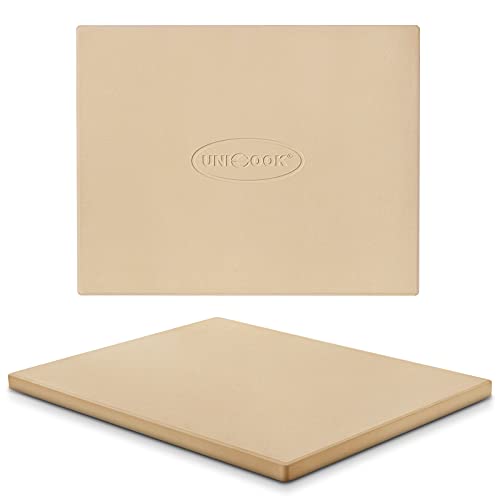
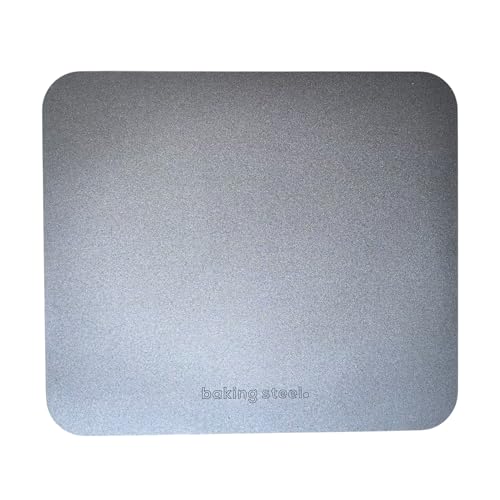
The five tools that do the work in every method on this site: a slab that stores heat, something to launch with, a way to read the surface, and a clean cut.


The short answer, and why force is always the wrong response
Pizza dough is a net. Gluten forms when two proteins in wheat flour, glutenin and gliadin, hydrate and link into long strands, and those strands cross-link into a three dimensional mesh that traps the carbon dioxide the yeast produces. When that mesh is well built and relaxed, stretching it is a matter of persuading the whole sheet to thin out at once. When the mesh is thin, short, tight or chilled, the sheet cannot distribute the load, so the weakest square inch takes all of it and opens up. That is the entire mechanism, and it explains why pulling harder never works. Harder pulling raises the load on a net that is already at its limit.
So the honest first move when dough tears is to stop and put it down. A ten to twenty minute rest under a cloth costs you nothing and fixes a genuinely surprising proportion of tearing, because the gluten strands under tension slowly slide past one another and settle into a longer relaxed length. That relaxation is the same mechanism behind dough that springs back when you stretch it, which is the close cousin of this problem: springback is a net that pulls itself home, and tearing is a net that fails first. Both are answered by rest.
Cause one, the gluten was never developed in the first place
You cannot relax a net that was never built. If the mix was short, the dough leaves the bowl with glutenin and gliadin only partly linked, and no amount of resting or warming turns a partly built mesh into a complete one. This is the failure mode most home bakers underestimate, because the dough looks smooth long before it is actually strong. It feels finished, it balls up nicely, and then it tears the moment it is asked to thin out to a few millimetres.
For a sense of how much work the dough actually wants, the specification is unusually concrete. Commission Regulation (EU) No 97/2010 specifies 20 minutes of kneading at low speed for Pizza Napoletana, worked against 1.8 kg of flour per litre of water. That is not a number you have to obey, and hand kneading and modern spiral mixers do not map onto it cleanly, but it is a genuinely useful anchor: the legal definition of this dough involves twenty minutes of mechanical work, not two. If you mixed for four minutes and your dough tears, you have found your cause without needing to look any further.
The regulation also specifies the flour that dough is made from, which matters here: W 220 to 380, protein 11 to 12.5 g percent, dry gluten 9.5 to 11 g percent, absorption 55 to 62 percent, stability 4 to 12 minutes. A flour at the strong end of that band both tolerates and requires more mixing than a soft one. If you are working with a pizza-specific Italian 00 like Caputo Pizzeria, whose manufacturer page prints W 260/280 and protein 12.50 percent, you are firmly inside that band and the dough will happily take a long mix.
Cause two, the dough came straight out of the fridge
This is the most common single cause and the easiest to fix, which is why it is worth ruling out early. Cold gluten is tight. A dough ball taken from the fridge and stretched immediately has two problems at once: the gluten strands are stiff and unwilling to slide past each other, and the ball has usually not had the room-temperature rest that lets it finish rising. It behaves like cold rubber, resisting until it fails, and it fails suddenly rather than gradually.
The regulation is explicit that the second rise happens warm. The EU regulation specifies four to six hours at room temperature after the dough is divided into balls, with a fermentation temperature of 25°C given for the process. Whatever schedule you run, the last stretch of it is meant to happen with the dough warm and relaxed, not chilled. Dough that has been refrigerated needs to come back up before it will behave, and that is not a five minute job for a dense 250 g ball. Give it real time on the counter, covered, in a dough proofing box or a lidded dough tray so the surface does not dry into a skin while the middle warms.
Do not try to shortcut this with heat. A ball warmed aggressively from the outside ends up with a warm, slack skin over a cold, tight core, and that boundary is precisely where it tears, usually in a ring. Even, patient warming is the only version of this that works. If you run a refrigerated schedule as a matter of course, our cold ferment versus same day dough page covers what that schedule buys you and what it costs you at the bench.
Cause three and four, underproofed versus overproofed (the diagnostic almost nobody teaches)
Here is the part that actually separates people who can fix their dough from people who keep guessing. Both underproofed and overproofed dough tear, and beginners routinely misdiagnose one as the other and then apply the fix for the wrong one, which makes it worse. The two failures feel completely different once you know what you are feeling for.
Underproofed dough fights you. It is firm, it resists the stretch, and it actively pulls back toward the centre as you work. When it finally tears, it tears against resistance, with a bit of a snap, and the edges of the hole are tight and clean. A finger poke rebounds fast and fully. This dough has not had its second rise, and the fix is straightforward: cover it and wait. The EU regulation gives four to six hours at room temperature after balling on top of a two hour first rise, so six to eight hours in total, while AVPN's published recipe frames total leavening as minimum 8 and maximum 24 hours. Those two authorities do not agree, and we are not going to pretend they do; print both, and note that either one is a great deal longer than the ninety minutes a lot of home recipes suggest.
Overproofed dough does the exact opposite. It is slack, wet-feeling and sticky, it does not spring back at all, and it tears open with no resistance whatsoever, leaving ragged, over-thin edges. A finger poke stays dented or the ball deflates. This is not a net under tension, it is a net that has been broken down: the fermentation has run so far that enzyme activity and acidity have degraded the gluten structure, and there is nothing left to stretch. The cruel part is that no amount of resting helps, because resting is what caused it.
Cause five, not enough protein in the flour for the way you are handling it
If tearing follows you across sessions and schedules, look at the bag rather than at your hands. Flour protein sets the ceiling on how strong a gluten net you can possibly build, and the published figures make the differences concrete. King Arthur Baking publishes all-purpose flour at 11.7 percent protein and bread flour at 12.7 percent, with pastry flour at 8 percent, cake at 10 percent, whole wheat at 13.2 percent and high-gluten at 14.2 percent. King Arthur states the principle plainly, that the higher the protein content, the stronger the flour, and that gluten strands become longer and stronger the more the gluten develops, which leads to more chewiness and toughness in the finished product.
That single percentage point between 11.7 and 12.7 sounds trivial and is not. It is the difference between a net that thins out to a translucent field across a 12 inch base and a net that runs out of material and gives way in the middle, and it becomes much more visible the thinner you stretch, which is exactly what a hot pizza oven asks for. If you are stretching an all-purpose dough as thin as a Neapolitan base, you are asking a flour for something it was not milled to do. Our pizza flour protein content page lays the whole ladder out, and best flour for pizza dough covers which bag to reach for.
The practical move is to step up. A stronger 00 pizza flour or a bread-flour-strength blend gives the same technique more margin. One honesty note: King Arthur does not publish a protein percentage for its own 00 Pizza Flour on its protein article or its flour-for-pizza article, so we do not print one. That is a genuine gap in the published record. Caputo, by contrast, does publish for Pizzeria: W 260/280, P/L 0.50/0.60, protein 12.50 percent.
Cause six, your hands, and the rolling pin you should not own
Everything above happened before you touched the dough. This one is happening right now. Fingertips concentrate force into points, and a point load on a thin gluten sheet is the textbook way to start a hole. Pressing out the middle of the disk with fingertips is fine and correct; stretching with fingertips is not. Once the disk is formed, get onto the backs of your hands with the knuckles up, move your hands apart slowly, and rotate the dough so the load keeps moving around the sheet rather than sitting in one place. Gravity does the work and your hands only steer.
A rolling pin is worse than fingertips for a different reason. It does not usually tear the dough on the bench, it ruins it structurally: it presses the carbon dioxide out of the whole disk including the rim, which both destroys the puff a hot oven exists to create and leaves a denser, less extensible sheet that is more prone to splitting when you lift it. There is no version of high-heat pizza where the pin is the right tool.
And then there is simple speed. Dough responds to slow, steady load and fails under fast load, in the same way that a piece of chewing gum stretches when pulled slowly and snaps when pulled quickly. If you are stretching a base in fifteen seconds, slow down to sixty and rest halfway through. Working over a lightly floured bench with a bench scraper to lift and move balls without dragging them helps a lot here, as does a light dusting of semolina so the disk glides instead of gripping and pulling against itself. The rest of the bench kit is in best pizza dough tools.
Patching a hole, and when to give up on the ball
Patch on the bench, always, and always before the sauce. A small tear in an untopped base is a two second repair: pinch the edges of the hole back together with slightly damp fingertips and press the seam flat against the bench, or take a small scrap of dough from the outer edge, lay it over the gap and press it in. It will bake essentially invisibly. What you must not do is carry a holed base to the peel and top it, because sauce runs through the hole, welds the pizza to the peel, and then the hole becomes a fold and the fold becomes a ruined launch. The mechanics of that failure are in how to launch a pizza.
Knowing when to stop is a skill too. Give up on the ball when it tears repeatedly in different places after a rest, when it feels slack and sticky and refuses to hold any shape at all, or when it has visibly deflated, all of which point to overproofing that cannot be undone. Also give up when a ball is simply too small for the pizza you are trying to make, which is a surprisingly common hidden cause: the EU regulation gives dough balls of 180 to 250 g and AVPN's published recipe gives 200 to 280 g for a pizza of at most 35 cm, so if you are pulling a 150 g ball out to 14 inches you are asking for a hole. Our how much dough per pizza page does that arithmetic by diameter.
How to Diagnose and Fix Pizza Dough That Tears
- 1
Stop pulling and put the dough down
The instant you feel resistance turn into a thin spot, stop. Every additional second of pull concentrates force on the weakest point in the sheet. Lay the dough flat on a lightly floured bench, cover it, and give it ten to twenty minutes. More often than not the dough that would have torn will stretch cleanly after a rest, because you have changed nothing except the time.
- 2
Check the temperature of the dough, not the room
Press a fingertip into the ball. If it feels cool and the dent springs back instantly and completely, the dough is still cold and tight, and cold gluten has no give. Leave the balls covered at room temperature until they feel soft and slightly slack and a gentle dent fills back in slowly. Do not try to rush this with a warm oven or a hot windowsill; uneven warming gives you a warm skin over a cold core, which tears at the boundary.
- 3
Decide whether it is underproofed or overproofed
This is the fork in the diagnosis. Underproofed dough fights you: it resists, snaps back toward the middle, and when it finally rips it does so with obvious resistance and clean, tight edges. Overproofed dough does the opposite: it is slack, wet-feeling and sticky, it does not spring back at all, and it tears open without resisting, with ragged, thin edges. Confirm with a poke, an underproofed ball rebounds fast, an overproofed one keeps the dent or collapses.
- 4
If it is underproofed, give it its second rise
The EU regulation specifies a second rise of four to six hours at room temperature after the dough is divided into balls, on top of a two hour first rise. AVPN's published recipe frames total leavening as minimum 8 and maximum 24 hours. If your balls have had a fraction of that, they are simply not ready, and no stretching technique substitutes for the missing hours. Cover them and come back.
- 5
If it is overproofed, accept it and change the plan
Overproofed dough cannot be un-proofed. The gluten has degraded and the ball will keep tearing no matter how gently you work. You can sometimes rescue it by handling it as little as possible, shaping a smaller and slightly thicker base, and baking it quickly. Otherwise the honest move is to bin that ball and shorten the schedule next time, or drop the yeast quantity so the same schedule ferments more slowly.
- 6
Check whether your flour has the protein for the job
If dough tears consistently across sessions, look at the bag. King Arthur publishes all-purpose flour at 11.7 percent protein and bread flour at 12.7 percent, and says plainly that the higher the protein content, the stronger the flour. A percentage point of protein is the difference between a net that thins out and a net that gives way, particularly if you are stretching thin for a hot oven.
- 7
Stretch with the backs of your hands, never fingertips
Fingertips are ten small points of concentrated force, and concentrated force is how a hole starts. Drape the disk over the backs of both hands with the knuckles up, move your hands apart slowly, and rotate so the load moves around the whole sheet instead of sitting in one place. Never use a rolling pin: it crushes the gas out of the rim and produces a dense sheet that both tears and bakes badly.
- 8
Patch the hole before you top the pizza
A small hole in an untopped base is a two second repair. Pinch the edges of the tear back together with slightly damp fingers and press the seam flat, or lay a small scrap of dough from the edge over the gap and press it in. Patch it now, on the bench. A hole discovered after the sauce goes on means sauce on the oven floor and a pizza that welds itself to the peel.
Ready to buy? Start with our top picks
Whatever this guide steered you toward, here's where most readers land, ranked on stated floor heat. Live price check on each.
- Check price on Amazon
- Check price on Amazon
- Check price on Amazon
- Check price on Amazon
- Check price on Amazon
- Check price on Amazon
As an Amazon Associate we earn from qualifying purchases, at no cost to you.
How we chose.
Kneading time, rise schedule, fermentation temperature and dough ball weights are quoted from Commission Regulation (EU) No 97/2010, the Pizza Napoletana TSG, read directly from EUR-Lex.
Total leavening time of minimum 8 and maximum 24 hours, and dough balls of 200 to 280 g, are quoted from AVPN's own published recipe page. Where AVPN and the EU regulation disagree we print both figures and attribute each one rather than averaging them.
Flour protein percentages are King Arthur Baking's published figures from its article on protein percentage in flour, dated 25 September 2023. The W value, P/L ratio and protein figure for Caputo Pizzeria are from Mulino Caputo's own product page.
This is a research and verification desk. We do not run physical baking trials, and nothing on this page is presented as the result of one. Claims that are practitioner consensus rather than published specification are labelled as such.
King Arthur does not publish a protein percentage for its own '00' Pizza Flour on the pages we checked, so we do not print one. That is a real gap in the published record, not an oversight on our part.
Key terms
- Gluten net
- The three dimensional mesh of linked glutenin and gliadin strands that forms as flour hydrates and is worked. It traps fermentation gas and distributes stretching load across the whole sheet. A net that is underbuilt, chilled or degraded cannot spread the load, so one spot takes it all and tears.
- Underproofed tear
- A tear in dough that has not finished its rise. The dough resists, snaps back toward the centre, and rips against obvious resistance with tight, clean edges. A finger poke rebounds fast and fully. The fix is time: the EU regulation gives four to six hours at room temperature after balling.
- Overproofed tear
- A tear in dough that has fermented too far. The gluten has degraded, so the dough is slack, sticky and wet-feeling, does not spring back at all, and opens without resistance leaving ragged edges. A poke stays dented. It cannot be rested back into shape; the schedule or the yeast quantity has to change next time.
- Extensibility
- The dough's willingness to stretch and stay stretched rather than pull back. It comes from developed gluten, adequate hydration and a relaxed, room-temperature ball. It is the property tearing dough lacks, and it is the counterweight to elasticity in the Italian P/L ratio.
- W value
- The Italian measure of flour strength, from a Chopin alveograph. The EU regulation specifies W 220 to 380 for Pizza Napoletana flour; Mulino Caputo publishes W 260/280 for its Pizzeria flour. A higher W flour supports a longer fermentation and more handling before the net gives out.
- Windowpane check
- Stretching a small piece of dough between the fingers to judge gluten development. A well-developed dough thins to a translucent film without splitting; an underdeveloped one goes opaque and rips. It separates a mixing problem, which affects every ball in the batch, from a proofing or handling problem, which affects one.
Questions, answered
why does my pizza dough tear when i stretch it
Almost always because it is underdeveloped, underproofed or too cold, and all three are fixed with time rather than force. Underdeveloped dough never built enough gluten to spread the load, so it tears everywhere and fails a windowpane check. Underproofed dough has not had its room-temperature rise, so it fights you and rips against resistance. Cold dough has stiff gluten with no give and splits suddenly. Rest the dough covered for ten to twenty minutes before anything else, and if that fixes it, the cause was tension or temperature. If every ball in the batch tears the same way, look at the mix instead: the EU regulation for Pizza Napoletana specifies 20 minutes of kneading at low speed.
how do i know if my pizza dough is underproofed or overproofed
Poke it and watch the dent. Underproofed dough rebounds fast and fully, feels firm, fights the stretch, pulls back toward the centre, and when it tears it tears against resistance with tight, clean edges. Overproofed dough is the opposite: the dent stays or the ball deflates, the dough feels slack, sticky and wet, it does not spring back at all, and it opens up without resisting, leaving ragged, over-thin edges. The distinction matters because the fixes are opposites. Underproofed dough needs more time, and both the EU regulation, at four to six hours at room temperature after balling, and AVPN, at minimum 8 to maximum 24 hours total leavening, describe a lot more time than most home recipes. Overproofed dough cannot be rescued by waiting; you shorten the schedule or cut the yeast next time.
why does my pizza dough have holes in it
Holes come from load concentrating on one weak point rather than spreading across the sheet. The three structural causes are an underbuilt gluten net from too short a mix, a ball that is still cold and tight from the fridge, and dough that has overproofed so far that the gluten has degraded. The two handling causes are stretching with fingertips, which are ten points of concentrated force, and stretching too fast, because dough yields to slow steady load and snaps under quick load. There is also a quiet fourth cause: a ball that is simply too small for the diameter you are stretching to. The EU regulation gives 180 to 250 g balls and AVPN gives 200 to 280 g, for a pizza of at most 35 cm.
can you fix a hole in pizza dough
Yes, easily, as long as you do it on the bench before the pizza is topped. Pinch the edges of the tear back together with slightly damp fingertips and press the seam flat against the work surface, or take a small scrap of dough from the outer edge, lay it over the gap and press it in. Patched dough bakes essentially invisibly. What you cannot fix is a hole discovered after the sauce is on: sauce runs through, glues the base to the peel, and the pizza folds during the launch. Check for holes by lifting the stretched disk and looking at it against the light before you top it.
does cold dough tear more easily
Yes. Cold gluten is stiff and the strands are unwilling to slide past one another, so a chilled ball resists and then fails suddenly instead of thinning gradually. A refrigerated ball has usually also missed the warm second rise the specification describes: the EU regulation gives four to six hours at room temperature after balling, with a fermentation temperature of 25°C. Let refrigerated balls come up to room temperature fully, covered so they do not skin over, and give a dense 250 g ball real time rather than minutes. Do not warm them aggressively from the outside, because that leaves a slack warm skin over a tight cold core and the dough tears at that boundary, often in a ring.
what flour stops pizza dough from tearing
A stronger one, though flour is the last thing to change rather than the first. King Arthur publishes all-purpose at 11.7 percent protein and bread flour at 12.7 percent, and says the higher the protein content, the stronger the flour. That one percentage point is the difference between a net that thins to a translucent field and one that gives way in the middle, and it matters most when you stretch thin for a hot oven. The EU regulation specifies flour at protein 11 to 12.5 g percent and W 220 to 380 for Pizza Napoletana, and Caputo publishes W 260/280 and protein 12.50 percent for its Pizzeria flour. Note that King Arthur does not publish a protein figure for its own 00 Pizza Flour, so we do not quote one.
Filed under Explainer
Keep reading.
Why Does My Pizza Dough Spring Back?
The close cousin of tearing: a gluten net that pulls itself home, why the P/L ratio measures it, and the stage-and-rest cure.
How to Stretch Pizza Dough (2026)
The correct motion from the beginning: pressing the rim, the draping stretch, and the geometry a hot floor needs.
Cold Ferment vs Same Day Pizza Dough
What the two governing documents actually specify, why neither describes a 48 hour cold ferment, and how yeast quantity sets the schedule.
Pizza Flour Protein Content
King Arthur's published ladder from 8 to 14.2 percent, the EU flour specification, and which bag suits which style.
How Much Dough Per Pizza
Ball weight by diameter, derived from the regulation's own 180 to 250 g for a 35 cm pizza. Undersized balls tear.
How to Launch a Pizza (2026)
Why a holed or patched base has to be caught at the bench, and the shake test that stops a tear becoming a folded pizza.